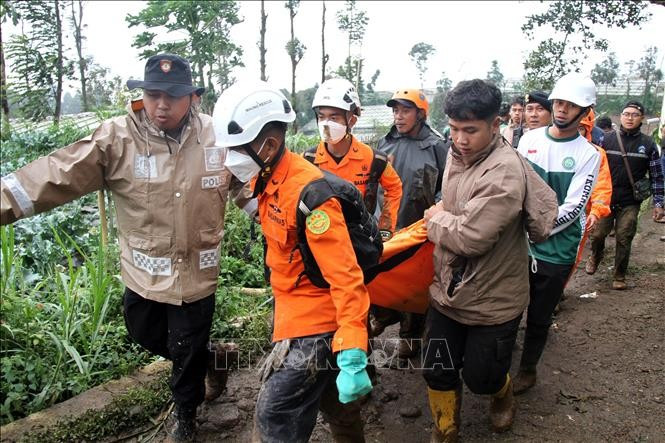
Rescue workers transport victims’ bodies at the scene of the landslide in West Bandung, West Java Province, Indonesia, on January 24, 2026.
According to the latest data from West Java’s Regional Disaster Management Agency, cited by Vietnam News Agency correspondents in Jakarta, the disaster struck in the early morning of January 24, leaving at least 19 people dead and around 73 others still missing. More than 600 residents have been urgently evacuated after their homes were destroyed or deemed unsafe. As of the evening of January 25, authorities had transferred 25 body bags to the Disaster Victim Identification unit for identification procedures.
During an on-site inspection in Pasirlangu Village, Cisarua District, on the afternoon of January 25, Indonesian Vice President Gibran Rakabuming Raka instructed local authorities to urgently investigate and strictly address illegal land-use conversions, which are believed to be a key factor behind the disaster.
“I urge the Deputy Governor and the Regent to take immediate action regarding land conversion issues. This area needs to be restored to forest function as the risk of recurrent landslides remains very high,” he stated.
Vice President Gibran also stressed that relocating residents to safe areas is the top priority, while ensuring essential needs are met for vulnerable groups such as the elderly, children, and pregnant women.
Regarding the cause of the disaster, geological experts from the Bandung Institute of Technology assessed that the event was not a typical landslide but rather a “mudflow” triggered by the collapse of a natural upstream dam. The combination of prolonged heavy rainfall, weathered volcanic soil, and the conversion of forest land into vegetable cultivation on steep slopes severely destabilized the soil structure.
Indonesia’s Ministry of Environment announced it would dispatch a team of experts to the site within the next one to two weeks to assess ecological and geological impacts and propose scientific mitigation measures. Meanwhile, Home Affairs Minister Tito Karnavian called on local authorities nationwide to review spatial planning, particularly in areas at high risk of hydrometeorological disasters.
At present, the Bandung municipal government and relevant agencies are urgently distributing food supplies, clothing, and setting up community kitchens to support evacuees in temporary shelters.