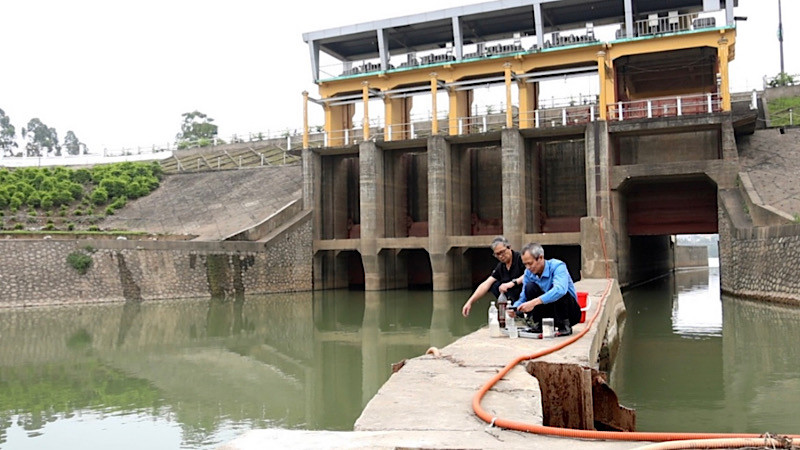
Water quality inspection at Xuan Quan temporary pumping station. (Photo: nhandan.vn)
The Ministry of Agriculture and Rural Development (MARD), in collaboration with the Ministry of Natural Resources and Environment (MONRE), recently issued Document No. 2138/BNNMT-MT responding to voters' petitions following the 10th Session of the 15th National Assembly.
This move follows a petition from Hanoi voters, forwarded by the National Assembly’s Board for Voluntary Aspirations and Supervision on January 16, 2026. Voters called for integrated solutions to combat flooding and landslides, enhance disaster response and mitigation, and improve early flood forecasting—particularly regarding timely notifications of reservoir discharges to help residents proactively evacuate and protect lives and assets.
Integrated Planning for the Red-Thai Binh River Basin
The Ministry stated it has advised the Prime Minister on the "Irrigation Planning for the Red-Thai Binh River Basin for 2022-2030, with a vision to 2050." The plan proposes comprehensive drainage and flood control strategies for the entire basin, including the capital, Hanoi.
Key measures include:
-
Adjusting Operational Procedures: Fine-tuning the operation of reservoirs and irrigation systems to handle extreme rainfall and floods exceeding design frequencies.
-
New Infrastructure: Proposing the construction of the Van Lang reservoir on the main current of the Cau River to coordinate with tributary reservoirs in regulating and reducing downstream floods.
-
Inter-provincial Management: Reviewing and approving updated operational procedures for major irrigation systems (such as the Nhue, Bac Hung Hai, and Bac Nam Ha rivers) to ensure proactive drainage for agriculture and water quality improvement.
Regarding local irrigation works, the Ministry urged provincial authorities to enforce laws on irrigation, environmental protection, and water resources. This ensures that wastewater discharged into these systems is treated to meet standards. Localities are also encouraged to upgrade infrastructure to adapt to climate change and prevent urban and agricultural flooding.
Prioritizing Disaster Prevention and Early Warning
In response to increasingly extreme and unpredictable weather, the Government has submitted several strategic frameworks to the Secretariat and the Prime Minister. These include the National Strategy for Natural Disaster Prevention and Control until 2030 and a specific scheme for riverbank and shoreline erosion prevention.
Looking ahead, the Ministry will focus on several synchronized solutions to enhance early warnings:
-
Modernizing Infrastructure: Implementing the "National Meteorological and Hydrological Station Network Plan" and a modernization scheme through 2030. This includes expanding the weather radar network and offshore sensors (in Hai Phong, Da Nang, Nha Trang, and Ca Mau) to close observation gaps in the East Sea.
-
Applying Advanced Technology: Researching the application of Artificial Intelligence (AI) to improve the accuracy of forecasts. The goal is to shift from "weather forecasting" to "impact-based forecasting," providing detailed warnings at the ward and commune levels with longer lead times.
-
Real-time Data Transmission: Upgrading high-speed, stable data transmission networks to ensure zero interruptions during severe weather events.
-
Localized Modeling: Developing and domesticating meteorological and hydrological models tailored to Vietnam's unique conditions, integrating physical, statistical, and AI-driven models for maximum precision.
The Ministry emphasized that it will continue to monitor hydrometeorological developments closely, providing early assessments to the National Steering Committee for Civil Defense and local authorities to ensure timely and effective disaster response.