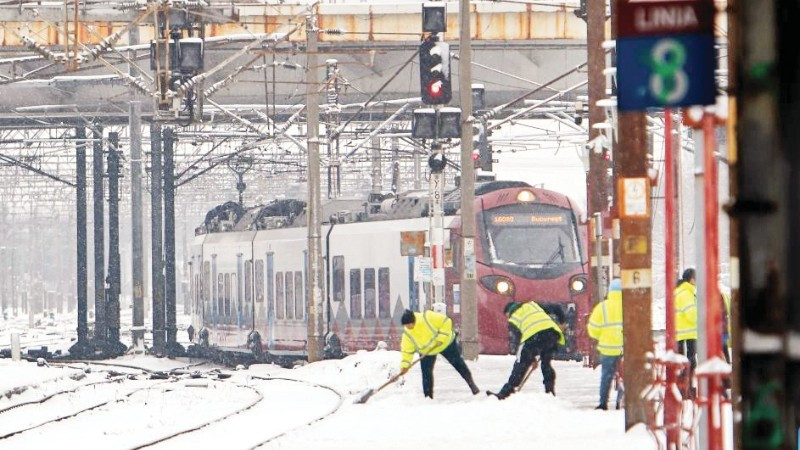
Snow removal workers clear tracks at a railway station in Bucharest, Romania. (Photo: Xinhua News Agency)
The Finnish Meteorological Institute forecast that from January 12, an intense cold air mass would continue to cover Kittilä in northern Finland, with temperatures expected to drop to nearly minus 40 degrees Celsius. Earlier, on January 11, Finland’s national public broadcaster Yle reported that temperatures at Kittilä Airport had fallen to minus 37 degrees Celsius, forcing airlines to cancel numerous flights and leaving thousands of tourists stranded.
On the same day, prolonged delays and cancellations continued to affect Germany’s railway system. On January 12, German authorities announced the closure of all schools in the state of North Rhine-Westphalia, switching to online learning due to icy road conditions across the region. In Baltic countries such as Estonia and Lithuania, authorities advised residents to limit travel as much as possible because of blizzard risks.
In Russia, the country’s civil aviation authority warned that heavy snowfall had increased the time required to clear runways and aprons, while also disrupting airport services and causing baggage handling delays. Meteorological officials forecast that the second wave of Storm Francis was approaching the capital, Moscow, and could once again impact the city’s airports.