
Workers are mobilized to clear snow in Beijing, China, on January 18, 2026. Photo: THX/TTXVN
In China, a powerful cold front has swept across numerous provinces and cities, forcing schools to close, placing snow-removal teams on standby, and prompting widespread cold-wave alerts. In Jiangsu Province, the city of Xuzhou suspended classes for kindergarten, primary, and secondary school students on January 19 and 20 amid forecasts of heavy snowfall and freezing conditions.
Meteorological authorities warned that from January 19, blizzards could hit Xuzhou, Suqian, and Huai’an, with snow accumulation expected to reach 5–8 centimeters, accompanied by strong winds and icy road conditions. Other parts of Jiangsu have also been alerted to frost risks that could damage crops and increase traffic accidents due to slippery roads.
In Henan Province, authorities implemented emergency measures to ensure traffic safety. As of January 19, 113 snow-removal and road maintenance machines had been deployed, using nearly 900 tons of de-icing agents. Across the province, 211 emergency supply stations were set up along expressways, with more than 6,700 maintenance workers, 217 rescue teams, and over 1,000 snowplows on standby.
In Hunan Province, meteorological authorities upgraded the cold-wave warning on the morning of January 19, stating that temperatures in most areas would drop below 0 degrees Celsius, accompanied by strong winds lasting until early January 21 (local time). Residents were advised to dress warmly, reinforce doors, windows, and temporary structures, and limit outdoor activities. China’s national meteorological agency also extended cold-wave alerts nationwide, warning that temperatures in many areas could fall by 6–10 degrees Celsius over the coming days.
Meanwhile, in Russia’s Far East, the Kamchatka Peninsula is facing its most severe snowstorm in decades. According to Kamchatka-Inform news agency, snow depth in some areas has exceeded two meters, with certain locations reaching up to 2.5 meters. In December 2025 alone, Petropavlovsk-Kamchatsky—the capital of Kamchatka Krai—recorded 370 millimeters of snowfall, more than three times the multi-year average. From January 1 to 16, the city received an additional 163 millimeters of snow, bringing total snow depth to 170 centimeters. Local meteorological officials described the phenomenon as extremely rare, with the last comparable event occurring in the early 1970s.
Heavy snowfall has isolated many residential areas, forcing residents to dig through snow just to exit their homes. Authorities in Petropavlovsk-Kamchatsky have declared a state of emergency, suspended some flights, and urged residents to keep children indoors. Schools and universities have either temporarily closed or switched to online learning.
In Ukraine, severe freezing weather combined with widespread power outages has left millions facing electricity and heating shortages. Temperatures in many regions, including the capital Kyiv, have dropped to minus 20 degrees Celsius. Approximately 58,000 workers are striving to restore power supplies, with additional crews deployed to Kyiv, where President Volodymyr Zelensky described the situation as “extremely difficult.
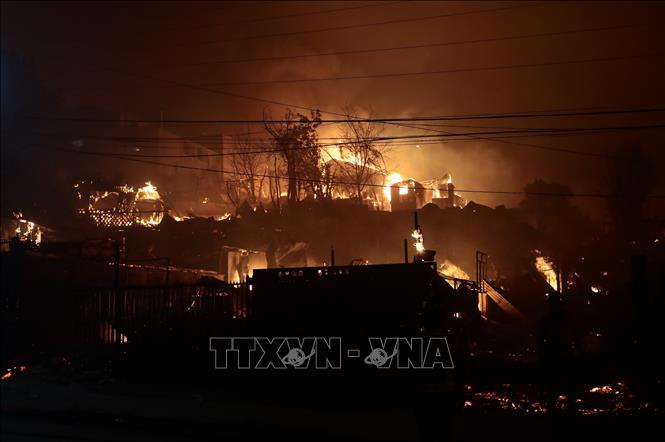
Wildfire in Penco, Biobío Region, Chile, on January 18, 2026. Photo: THX/TTXVN
In stark contrast to the freezing conditions in the Northern Hemisphere, parts of South America are reeling under intense heat and devastating wildfires.
In Chile, wildfires have claimed at least 19 lives and destroyed hundreds of homes, as authorities carry out large-scale evacuations and mobilize firefighting forces. As of late January 18, the National Forestry Corporation (CONAF) reported it was battling 23 active blazes, the most serious in the Ñuble and Biobío regions, where President Gabriel Boric has declared a state of disaster.
More than 20,000 hectares of land have been scorched in total. The largest fire, near the city of Concepción, has ravaged over 14,000 hectares, spreading rapidly through the towns of Penco and Lirquén and destroying numerous residential areas. Temperatures in parts of central and southern Chile are forecast to reach as high as 37 degrees Celsius, heightening the risk of further outbreaks.
In Argentina, wildfires have also erupted in the Patagonia region, burning approximately 15,000 hectares of forest amid prolonged heat since the start of the year.
Meanwhile, several Australian cities have recorded record-breaking rainfall, triggering floods and landslides during the wettest January day in nearly 40 years. Australia’s Bureau of Meteorology reported that Sydney received 126.8 millimeters of rain—the highest January rainfall since 1988—causing widespread road flooding and landslides and prompting emergency services to respond to thousands of calls for assistance.
According to Vietnam News Agency correspondents in Australia, the State Emergency Service (SES) handled 3,118 incidents across New South Wales and carried out 31 flood rescues within just 48 hours.
The simultaneous occurrence of extreme weather events across multiple continents underscores the growing abnormality of global climate patterns, posing significant challenges for disaster response, mitigation efforts, and the protection of communities worldwide.